
Driveways, patios & flatwork in Will County
Concrete Contractors in Joliet, IL
Slabs built to Joliet's permit rules and to its winters, with a written price before any work starts.
- Free on-site measuring visit
- Written quote broken out line by line
- Joliet driveway and sidewalk permits pulled by us, as the city requires
Concrete Work Planned for Joliet Lots and Joliet Winters
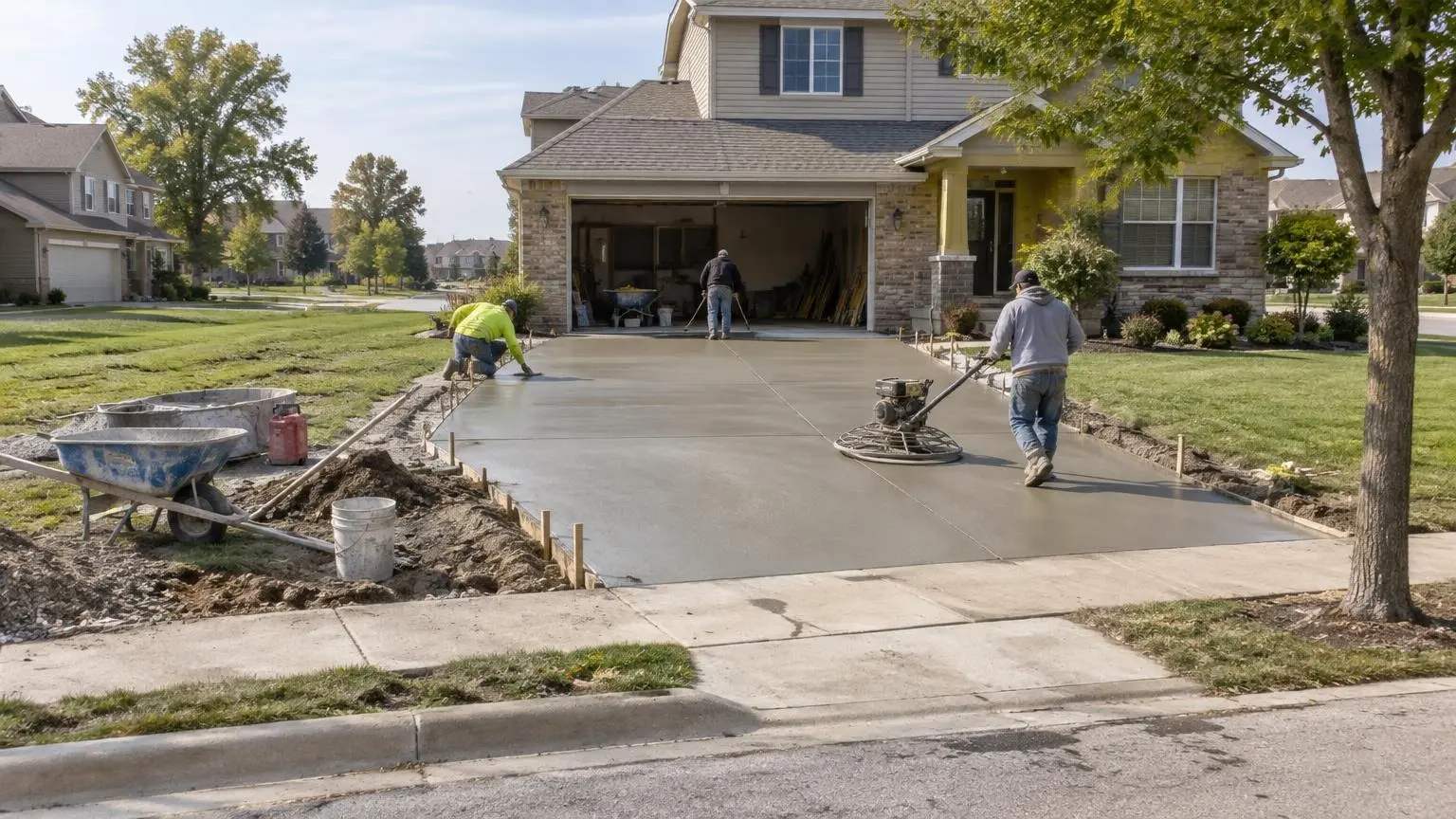
Concrete Contractors Joliet installs and repairs driveways, patios, stamped concrete, sidewalks, steps, garage floors and other slabs for homeowners in Joliet, Illinois. Joliet is a big city to cover. Wikipedia lists it at 150,362 people in the 2020 census and 65.82 square miles, split by the Des Plaines River into an east side and a west side, with a far west side reaching into Kendall County. A front walk on the East Side and a three-car driveway in a far west side subdivision are different jobs, but concrete contractors in Joliet face the same two tests on both: the city's permit rules and a northern Illinois winter.
A housing stock with two peaks
Point2Homes, summarizing Census survey data, puts the median build year of Joliet housing at 1985, but almost nothing was built near that middle. About 15.7 percent of homes date from 1939 or earlier, and another 23 percent from the 1940s through the 1960s. Then the city boomed: 17.6 percent of homes were built in the 1990s and 24 percent in the 2000s. Wikipedia's census table shows the population climbing from 76,836 in 1990 to 147,459 in 2010.
Each peak brings its own concrete problems:
- Older blocks near downtown, including the East Side Historic District (1980) and the Upper Bluff Historic District (1991), have walks, stoops and narrow drives that are often decades old, settled toward the house or lifted by parkway trees.
- 1990s and 2000s subdivisions have original driveways and patios that have now been through 20 to 30 winters. That is about when aprons crack at the street, panels near the garage sink and the surface starts to flake where salty slush sits.
What Joliet asks for before you pour
The City of Joliet's driveway and sidewalk permit page sets out rules that shape every residential quote we write inside city limits:
- A plat of survey marked with the new flatwork and its measurements is required for driveways, aprons, sidewalks and patios, including same-size replacements.
- The submission includes an installation plan (slab thickness, fill depth and surface material), a cost estimate and, when a contractor does the work, a copy of the contract. The contractor pulls the permit.
- Concrete driveways must be at least 4 inches thick with wire mesh, and 6 inches with wire mesh at approaches and sidewalk crossings.
- A residential driveway can be at most 20 feet wide at the front property line. The apron in the public right-of-way is limited to 20 feet at the sidewalk and 26 feet at the curb, and changes to it need Public Works approval.
- Driveways must be concrete, asphalt or brick pavers. Gravel is not allowed.
- Driveways and sidewalks must stay out of easements.
If you cannot find your plat, the city suggests checking closing papers, asking your mortgage company or filing a FOIA request with the City Clerk. We can help you track it down before the permit goes in.
Why outdoor concrete fails here
Wikipedia's climate table for Joliet gives a January average high of 31.1 degrees and a low of 16.6, with about 16.9 inches of snow and 38 inches of total precipitation a year. That puts outdoor concrete through a long run of freeze and thaw cycles, and every one of them works on a slab in three ways:
- Ice in the surface. Water soaks into the top layer, freezes and expands. Over a few winters the surface flakes off in thin chips, which is called scaling.
- Salt. De-icers keep the surface wet with brine and add extra freeze-thaw swings. Ammonium-based products also attack the cement paste.
- Frost under the slab. Wet soil freezes and lifts the concrete, then softens in spring and lets it drop. Slabs on a thin or poorly drained base crack into uneven pieces.
Our answer is the same on every exterior job: air-entrained concrete, a compacted crushed-stone base that drains, thickness matched to the load (and to the city's minimums), steel where the code or the load calls for it, control joints on a planned layout, and no salt during the first winter.
The services
- Concrete driveways: tear-out and replacement, widening within the city's 20-foot limit, new aprons and side pads.
- Concrete patios: broom, colored and exposed-aggregate patios with paths to the drive or gate.
- Stamped concrete: ashlar, slate, cobble and brick patterns on patios, entries and borders.
- Sidewalks and steps: front walks, side paths, stoops and poured steps.
- Slabs and garage floors: detached garage floors, shed pads, equipment and trash-can pads.
- Repair and leveling: mudjacking, foam lifting, resurfacing, crack sealing and panel replacement.
How a job runs
1. Measuring visit. We look at the area with you, measure, check how water moves, and note what affects the cost: what has to come out, slope, roots and truck access.
2. Written quote. Each part of the job is priced on its own line. If a repair would do the job, it is priced beside replacement.
3. Permit and locates. Inside Joliet we file the driveway or sidewalk permit with the marked plat. J.U.L.I.E. marks underground lines before digging.
4. Prep and pour. Demolition, soft soil dug out, stone compacted in layers, forms and mesh set, then the pour, finish and joints.
5. Cure and care. You get dates in writing. HomeGuide's driveway guide says to stay off for 24 to 48 hours on foot and at least 7 days with cars, and that concrete reaches full strength in 28 to 30 days.
Timing your project
Most outdoor pouring around Joliet happens between the spring thaw and the first hard freeze. Concrete that freezes before it gains strength can be ruined, so late-fall pours need a stretch of nights above freezing and sometimes insulated blankets. A slab poured in October also faces its first round of road salt before it has had a full season to dry out. If you call in the fall, we will tell you honestly whether to pour now or book a spring date. Call (815) 205-0805 to set up a visit.
Concrete Services in Joliet
Six kinds of residential concrete work, each priced in writing and built for Will County freeze-thaw winters.
Concrete Driveways
Driveway replacement, widening and new aprons, built on compacted stone at the thickness Joliet requires.
Learn more →Concrete Patios
Backyard patios in broom, colored or exposed-aggregate finishes, sized for how you use the yard and sloped away from the house.
Learn more →Stamped Concrete
Patterned and colored concrete for patios, entries, walks and borders, sealed for Illinois winters.
Learn more →Sidewalks & Steps
Front walks, side paths, stoops and poured steps, set at the right slope and kept out of easements.
Learn more →Concrete Slabs & Garage Floors
Floors for detached garages, shed pads and equipment slabs, sized and reinforced for what sits on them.
Learn more →Concrete Repair & Leveling
Mudjacking, foam lifting, resurfacing and crack sealing, plus honest advice on when replacement is the better buy.
Learn more →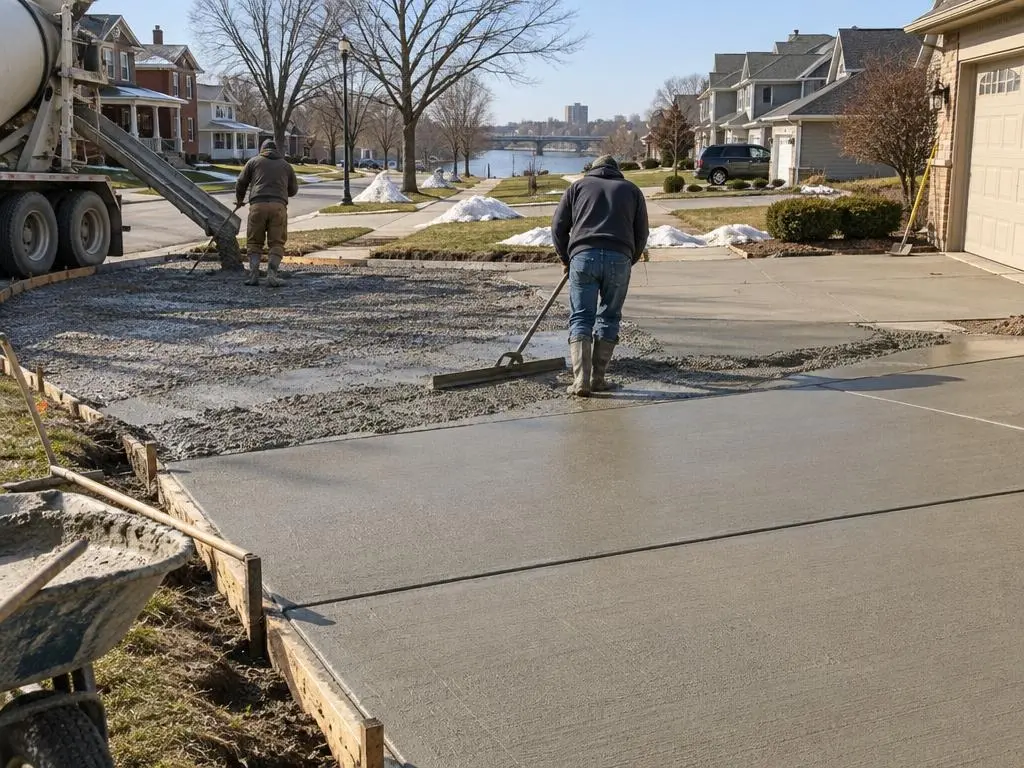
Common Questions
What is the average cost of a concrete driveway in Illinois?
We have not found a reliable Illinois-only figure. HomeGuide's national cost guide lists standard concrete driveways at $6 to $10 per square foot installed and $2,400 to $6,000 for a 20 by 20 foot two-car drive. Removing an old driveway adds $2 to $6 per square foot. Your measured, written quote is the real number for your driveway.
How much does a 200 square foot concrete driveway cost?
HomeGuide lists a 10 by 20 foot, 200-square-foot driveway at $1,200 to $3,000 at standard to basic quality. In Joliet, the 6-inch minimum at the apron and sidewalk crossing, tear-out and grading can push a small job toward the top of that range.
Do I need a permit to replace my driveway in Joliet?
The City of Joliet's driveway and sidewalk permit page asks for a plat of survey marked with the flatwork, even for a same-size replacement, plus an installation plan and cost estimate. When a contractor does the work, the contractor pulls the permit. We file it as part of the job.
How thick does a driveway have to be in Joliet?
Per the city's permit page, concrete driveways must be at least 4 inches thick with wire mesh, and approaches and sidewalk crossings must be 6 inches with wire mesh. We often go thicker where trucks, trailers or campers park.
Can I widen my driveway?
Usually, within limits. Joliet caps a residential driveway at 20 feet wide at the front property line, allows an existing driveway to be extended only toward the side property line, and requires driveways to stay out of easements. Changes to the apron need Public Works approval.
Are there free concrete contractors in Joliet?
Concrete work is not free, but the estimate is. We measure on site and give you a written, itemized quote at no charge and with no obligation.
Why does my concrete flake every spring?
That is scaling. Water in the top layer freezes and expands, and salt adds more freeze-thaw cycles and keeps the surface wet. Concrete without entrained air, slabs that were overworked during finishing and slabs salted in their first winter are most at risk. Light scaling on a sound slab can be resurfaced; deep, widespread scaling usually means replacement.
When can I drive on new concrete?
HomeGuide's driveway guide says foot traffic is fine after 24 to 48 hours, cars should wait at least 7 days, and full strength takes 28 to 30 days, which is the safe wait for heavy vehicles. We give you dates for your slab and that week's weather.
Why Homeowners Call Concrete Contractors Joliet
Permit-ready quotes
Thickness, fill and material on every quote match what Joliet asks to see on a driveway or sidewalk permit.
Built for freeze-thaw
Air-entrained concrete, a drained stone base and planned joints on outdoor slabs.
Line-by-line pricing
Tear-out, base, steel, finish and sealing listed separately, so bids are easy to compare.
Repair quoted when it works
Leveling or resurfacing priced next to replacement when the slab can be saved.
Where We Work
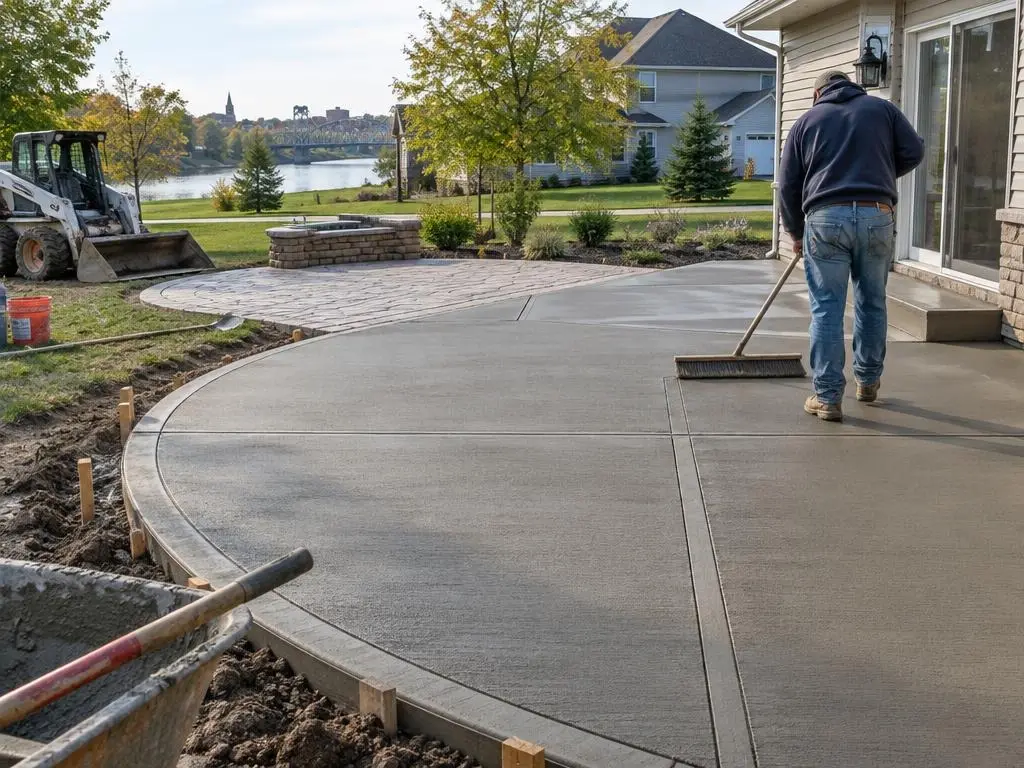
Most of our work is inside Joliet itself: the older East Side and West Side neighborhoods on both banks of the Des Plaines River, and the newer subdivisions on the far west side that cross into Kendall County. We also work in the towns around the city. To the north and northeast that means Crest Hill, Lockport, Romeoville and Bolingbrook; to the west, Plainfield, Shorewood, Channahon and Minooka; and to the east, New Lenox and Mokena. Each town page covers what we found about local housing and, where the city or village publishes them, its rules for driveways and flatwork. Permit rules change at the city limits, so we confirm what your address needs before we schedule.
- Concrete Contractors in Joliet, IL
- Concrete Contractors in Plainfield, IL
- Concrete Contractors in Bolingbrook, IL
- Concrete Contractors in Romeoville, IL
- Concrete Contractors in Lockport, IL
- Concrete Contractors in New Lenox, IL
- Concrete Contractors in Shorewood, IL
- Concrete Contractors in Crest Hill, IL
- Concrete Contractors in Mokena, IL
- Concrete Contractors in Frankfort, IL
- Concrete Contractors in Homer Glen, IL
- Concrete Contractors in Channahon, IL
- Concrete Contractors in Minooka, IL
- Concrete Contractors in Orland Park, IL
- Concrete Contractors in Tinley Park, IL
- Concrete Contractors in Manhattan, IL
- Concrete Contractors in Lemont, IL
- Concrete Contractors in Oswego, IL
- Concrete Contractors in Naperville, IL
- Concrete Contractors in Elwood, IL
- Concrete Contractors in Wilmington, IL
- Concrete Contractors in Morris, IL
- Concrete Contractors in Woodridge, IL
- Concrete Contractors in Rockdale, IL
Get a Free Concrete Estimate in Joliet
We measure on site and price the work in writing, in Joliet and the nearby Will County towns.